

weBoost Dash Cell Phone Signal Booster with Qi2 Wireless Charger | Boosts 5G/4G LTE All US Carriers | for Cars, SUVs, Trucks, Vans | Magnetic Mount | USA Made | FCC Approved
$199.99
Related Products


![[2-Pack] Wireless Charger, INIU 15W Qi-Certified Fast Wireless Charging Stand with Sleep-Friendly Adaptive Light Compatible with iPhone 16 15 14 13 12 Pro Max Plus Samsung Galaxy S22 S21 Note 20 etc](https://everyday-tech.co/wp-content/uploads/2025/12/71t9OSFlbaL._AC_SL1195_.jpg)




weBoost Dash Vehicle Signal Booster – 471082
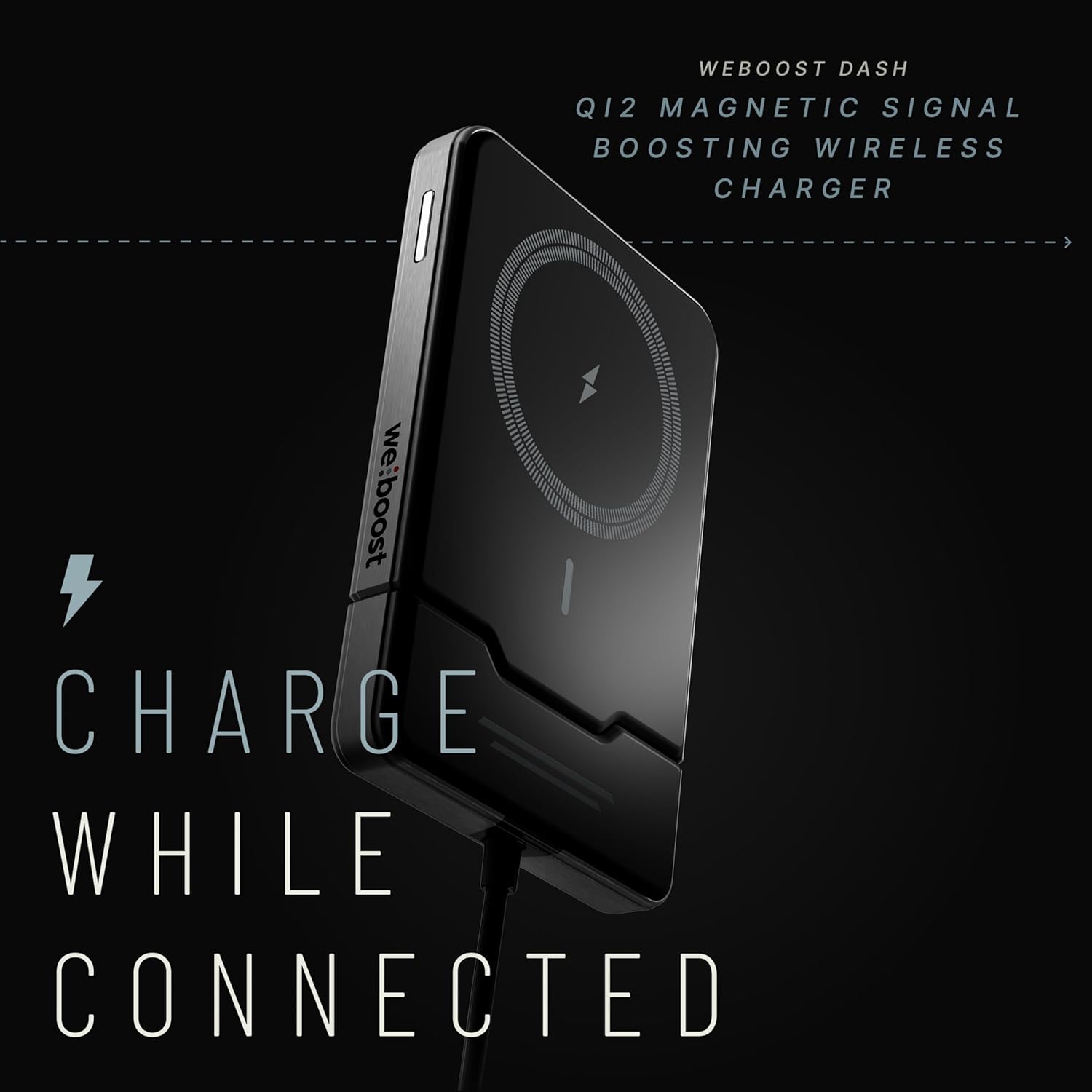
Boosts cell signal for one device with built-in Qi2 magnetic wireless charger for fast charging
Easy no-drill magnetic external antenna for simple install and removal
Cradle-free magnetic internal antenna for flexible customization
Works with all US and Canadian phones and carriers, boosts 5G and 4G LTE signals for better coverage
Includes adhesive metal ring – compatible with any MagSafe car mount for versatile vehicle installation (mount sold separately).
3 reviews for weBoost Dash Cell Phone Signal Booster with Qi2 Wireless Charger | Boosts 5G/4G LTE All US Carriers | for Cars, SUVs, Trucks, Vans | Magnetic Mount | USA Made | FCC Approved
Show all
Most Helpful
Highest Rating
Lowest Rating
Add a review

weBoost Dash Cell Phone Signal Booster with Qi2 Wireless Charger | Boosts 5G/4G LTE All US Carriers | for Cars, SUVs, Trucks, Vans | Magnetic Mount | USA Made | FCC Approved
$199.99
Steve –
Successfully got 1-bar areas to 2-bars, but won’t work in completely dead zones
This is weBoost’s entry level signal booster product for cars. Unlike some of its higher end cousins, this model isn’t one that you permanently put in a stationary vehicle (like an RV) or in a house. It’s meant to be used in a moving car.Also, unlike its higher end “Drive” product, this won’t work for multiple phones in a vehicle; it’ll work just for one phone that has to be physically connected to its base via a magnetic Qi2 or MagSafe magnet (it won’t work for tablets). If you don’t have a phone with a Qi2 or MagSafe magnet, they do provide magnetic ring “stickers” (if your phone doesn’t support Qi charging these stickers won’t magically make it charge, but it will position the phone properly for it to work with the signal boosting base).Even though they call it “portable”, setup is a bit of a pain, but a necessary one.You start by mounting the antenna outside the car near the center of the roof and at least a foot away from other antennas. The magnet is fairly strong, but even so it took me a while to get over the fear of the thing flying off. If your car roof is not magnetic, they include an adhesive sticker to stick to your car’s roof.You then need to thread the cable from the antenna into your car. If you have an SUV, the best way is to thread it through your hatchback; otherwise if you have a sedan you’ll want to thread it through a window or door. I was nervous about the cable getting cut by the door closing on it, but the cable seems pretty sturdy. I’d still avoid putting it through a window or door that you’re constantly opening and closing.Next, you connect the antenna to a “booster”, which is a slab of plastic about a foot long that you put in the trunk or under a seat, making sure the cables are secure so people won’t trip on them. Again, you’ll probably want to choose the least used door of the car to put the wires through.Next, you’ll connect the “booster” to power. It requires a cigarette lighter port.Finally, you’ll take another cable and wire it to the boosting charger. Like I said, it’s best to use a phone or phone case with a Qi2 or MagSafe ring already built-in; their “magnetic ring” stickers are okay in a pinch, but they peel off a bit too easily. Once you connect your phone to the magnet, you’ll want to adjust the boosting charger so that the bottom of your phone aligns to a certain area on the bottom of the boosting charger.As for performance, this is definitely one of those products where your mileage will vary.The one thing that’s definitely true is that it will NOT amplify a signal that’s not there (i.e. if you’re in a dead zone with zero bars).That said, I definitely found that in certain areas where I’d normally get 1 bar, I’d get 2 instead. We were able to confirm this via Verizon and T-Mobile. I wanted to test the actual signal strength to get actual dBm readings, but unfortunately, while their documentation said that their app offered this capability, I didn’t see it anywhere. Hopefully they’re still working on building that feature in as promised.Like I said, the unit isn’t exactly the easiest to properly install, but it is “portable” enough to take on trips, as long as you don’t mind taking the 20-30 minutes to get it set up properly (you’ll also need replacement stickers if the car you rent or borrow doesn’t have a magnetic roof). We recently went on a trip to some National Parks where the coverage was super spotty, and I feel this could have at least opened up a few more areas for us.Quality-wise, it’s excellently packaged, and made in the USA. I appreciated how unlike other vendors they don’t try to trap you into some kind of subscription model. They also offer a 30-day money back guarantee so you can make sure it works for you before you commit to keeping it.Overall, I found it a great value, but you’ll want to test it out for your driving route to make sure it is for you too.
B. Family –
I Wanted to Love It… But the Quirks Make It Hard to Recommend
I really wanted to love the weBoost Dash, I really did—but after using it extensively, I just couldn’t work around all the quirks and limitations.First, the Known Trade-OffsWith a portable, non-permanent booster like this, certain compromises are expected:• Exterior antenna routing:Because this isn’t designed for a permanent installation, getting the outside antenna cable into the vehicle is awkward. I routed mine through the trunk, and thankfully the gasket was thick enough to maintain somewhat of a watertight seal, but it’s not an elegant setup.• Phone compatibility:This system relies on a magnetic or adhesive-backed ring to align the booster with the back of your phone (primarily for MagSafe-style devices). That alone significantly limits what phones it works well with. If you switch cases frequently, use a non-MagSafe case, or share the car with multiple people, this becomes inconvenient very quickly.Functional Oddities That Hurt UsabilityHere’s where things started to go downhill:• Terrible for navigation use:Because the booster must be physically connected to the back of your phone, you can’t mount your phone in a normal dash or windshield holder. I found myself constantly looking down to check navigation—something that is both unsafe and annoying.• Awkward for calls:Holding the phone with the bulky booster plate and cable attached felt like stepping back into the 1980s. The extra thickness and tethered feeling make phone calls uncomfortable.Real-World PerformanceThis is where the product really broke my enthusiasm:• It can help in light rural dead zones:In areas where I normally might drop a call for a few seconds, the booster helped stabilize signal enough to continue the call. That part worked as advertised.• Completely useless in true no-signal areas:Out West, we have plenty of full dead zones. As expected, the weBoost Dash couldn’t generate a signal where none exists.• No noticeable improvements in urban or suburban areas:In the city, where I already have a strong 4G/5G signal, the device offered no improvement in speed or signal quality.Overall, I saw only very slight gains—and only where my signal was already partially usable.What I Wish This Product DidThis device would be 10x better if it had:• An omni-directional interior antenna mounted inside the vehicle• The ability to boost signal for every passenger’s phone, not just the one physically attached• A permanent exterior antenna option• A USB-C power input instead of the outdated 12V cigarette-lighter plugIn other words: build it more like a compact version of weBoost’s permanent vehicle boosters.Final ThoughtsUltimately, I struggled to find a practical, everyday use case for the weBoost Dash. It’s inconvenient to attach, awkward for navigation, and gives only mild improvements unless you’re in very specific “weak but not dead” coverage zones.If you want a real, reliable mobile signal-boosting solution, I’d recommend skipping this and looking at weBoost’s more traditional permanent vehicle boosters.For me, this one is a “meh.” Not terrible—but not useful enough to justify the price or the hassle.
Mike –
Reliable Booster for Filling Coverage Gaps
I regularly drive through areas where my cell signal becomes inconsistent. Just enough interference that I can hear parts of the conversation but not enough to completely drop the call. This cell phone booster performs exactly as advertised. It smooths out those weak-signal zones and keeps calls clear and uninterrupted during my commute and while traveling.I’m familiar with the larger, heavy-duty boosters used on construction sites to pull in a signal where none exists at all. Those systems are expensive, and more than most everyday users need. This unit is designed for a different purpose: improving marginal coverage, and it excels at that.The antenna includes both a magnetic base and a hardware option for permanent mounting. My Ford F-150 has an aluminum cab, so the magnetic mount wouldn’t adhere. Since I expect to trade the truck soon, I didn’t want to drill into it. Instead, I installed the booster in my wife’s vehicle, and it works perfectly there. She immediately noticed the improvement in call clarity.Overall, this is a practical, well-designed solution for anyone who experiences intermittent cell coverage and wants a straightforward way to improve call reliability without investing in a heavy-duty system.